23%
About 1 in 4 people clench or grind their teeth during the day
How to Release Tension From Your Jaw, Neck and Shoulders: 3 Things to Try Tonight
You can't sit comfortably. You can't lie comfortably. By the evening you're worn out, just from holding everything so tight. Here's why your body won't let go, and three free ways to help it.
Show me the 3 stepsFirst: Why the Tension Keeps Coming Back
Your Body Is Stuck on Guard
Under pressure, your body switches on "fight or flight" and tightens your muscles to protect you. The APA calls it "almost a reflex reaction to stress."
After a short scare, the muscles let go again. But everyday stress (work, money, family) doesn't end, so the signal to relax never comes. The muscles stay in "a more or less constant state of guardedness." APA, 2024
of people clench or grind their teeth while awake, and about 21% in their sleep. Zieliński et al., 2024
phone check-ins caught young adults holding their jaw tight or teeth together. Colonna et al., 2023
Under high stress, the jaw was relaxed in fewer check-ins. Emodi-Perlman et al., 2025
What Constant Tension Can Lead To
- Tension headaches from tight muscles in the shoulders, neck and head APA, 2024
- A painful jaw, earache and worn or broken teeth from clenching and grinding NHS
- Neck and shoulder pain. Neck pain alone affected 203 million people worldwide in 2020 GBD, 2024
- Disturbed sleep, when the body can't switch off at night NHS
Why the Usual Body Fixes Don't Last
They can bring real relief. But they work on the muscle, not on the reason it tightened. The next stressful email arrives, and the body braces again. By the next day, the tension is back.
The lasting fix is to give your body the "all clear" so it can stop bracing. These three steps do exactly that, for free.
3 Free Steps to Help Your Body Let Go
No equipment. Start with one, or do all three in under 10 minutes before bed.
Lips Together, Teeth Apart
Your jaw's natural resting position is lips closed, teeth not touching, tongue resting gently behind your top teeth. If your teeth are touching, your jaw muscles are working.
Slow Your Breathing and Let Your Shoulders Fall on Each Out-Breath
Breathe in through your nose for about 4 seconds, then out slowly for about 6. That's around 6 breaths a minute. On every out-breath, let your shoulders drop a little further.
Tense, Then Let Go, One Area at a Time
Lie on your back. Shrug your shoulders up to your ears and hold for 5 seconds. Then let them drop and notice the difference for 15 seconds. Do the same with your jaw (clench gently, then release), your hands, your stomach and your legs.
Jaw pain, clicking or locking, headaches that keep coming back, or worn teeth? Talk to your dentist or GP. A night guard or physiotherapy may be the right first step.
The Catch: These Steps Only Work When You Remember to Do Them
They work. But they ask for focus at exactly the moment you have the least of it: at the end of a long day, when your body is still wound up. Most people manage it for a week. Then the reminders get swiped away, and the shoulders creep back up.
That's why Finnish psychotherapist Marco Kärkkäinen created Neurosonic for his own clients with stress and sleep problems: a way for the body to let go without having to do anything.

Keep the free steps. Use Harmonia GO for the evenings when you're too wound up to do them.
How Harmonia GO Does the Letting Go for You
It's a thin mat that goes under your mattress or sofa cushions. You lie down, start a programme in the app, and that's it.
Here's what happens in your body during a session.
Gentle vibration
Spreads through your whole body, shoulders to legs.
Your body senses it
Cells in your muscles and tissues feel the movement.
Slow pulses
The rhythm rises and pauses, so your body keeps responding.
Rest and digest
Neurosonic designs it to switch on rest mode: heart rate slows, muscles let go.
What Researchers Measured During a Session
University of Oulu Study
Researchers at the University of Oulu, led by Professor Vesa Kiviniemi, tested what whole-body vibration from a Neurosonic device does in the body. Tuunanen et al., medRxiv, 2026
- Eyes closed for about 48% of the session
- More alpha waves, which the researchers linked to closed eyes and relaxed drowsiness
- No one reported discomfort from the vibration
15 Years of Professional Use
Neurosonic has been used by psychotherapists, physiotherapists, longevity clinics, spas and care homes for 15 years.
Harmonia GO is the home version: the same technology, in your own bed or on your sofa.
With Neurosonic+, the Insights feature connects your smart ring or watch, so you can follow your own heart rate variability (HRV) before and after each session.
The Oulu study is an early preprint (not yet peer-reviewed). It did not measure muscle tension, jaw clenching or teeth grinding, and its main findings involved vibration combined with a medicine. It does not show that Harmonia GO treats or prevents any condition.
★★★★★ 4.78 ★ (347)
"I've been a satisfied Neurosonic customer since 2018, when it helped me with a state of overload. Since then, I've used it regularly to help manage overstimulation. Harmonia makes it easier to use at home or while travelling. It's wonderful to fall asleep in my own bed with the vibrations or schedule a relaxation programme for the early hours of the morning. It's easy to share among family members and set up wherever it's needed most. The whole family benefits from Neurosonic."
"The effects are 5/5, exactly as promised. I couldn't live without Neurosonic anymore. It has helped with sleep, stress and nervous system recovery. Even my sceptical husband uses it, and he's more relaxed and cheerful. It's also a great addition to the facial treatments I offer my clients, taking relaxation to a whole new level."
"A good fit for someone whose work and hobbies are physically demanding. My recovery has become faster since I started using it."
"A really great device! It's compact and takes up little space, yet makes a big difference to recovery."
Swipe for more reviews →
Individual experiences vary.
The Easy Way to Let Go
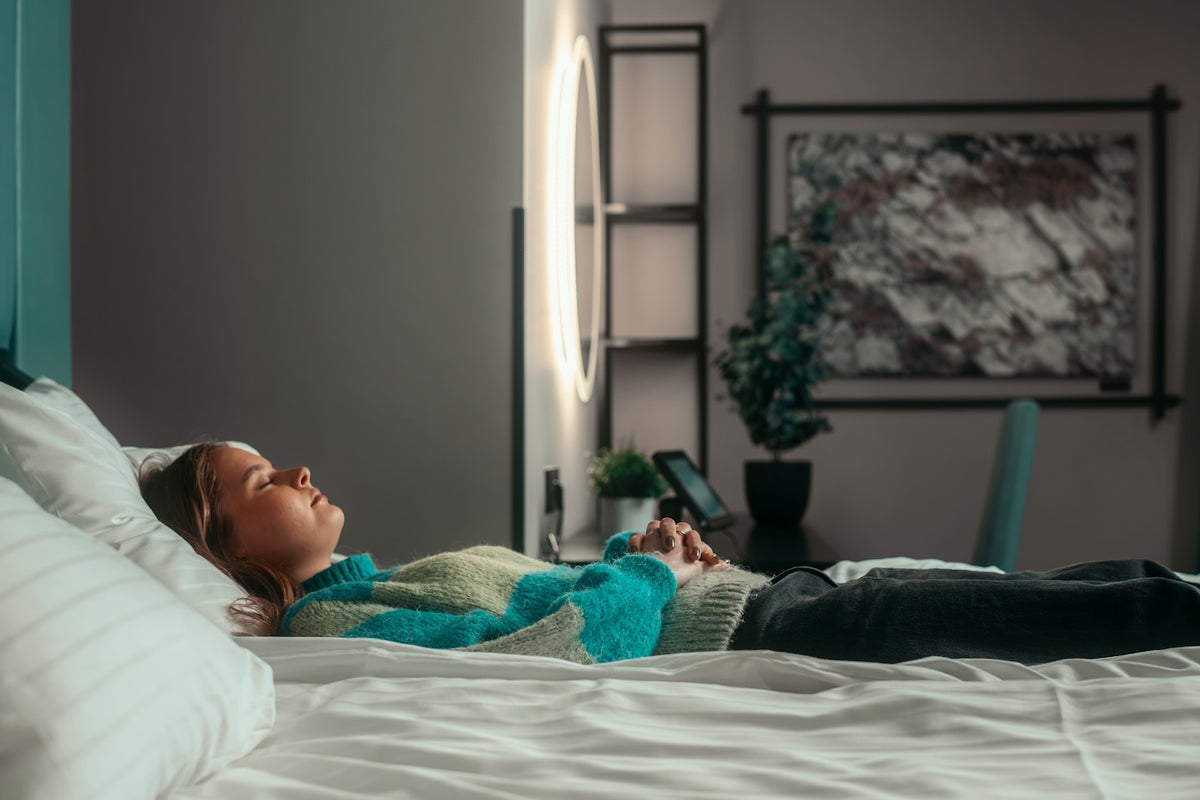
No routine to remember. Harmonia GO goes under your mattress or sofa cushions, and your body does the letting go while you lie back.
Sources
- American Psychological Association. Stress effects on the body (last reviewed October 2024). APA
- NHS. Teeth grinding (bruxism). NHS
- GBD 2021 Neck Pain Collaborators. Global, regional, and national burden of neck pain, 1990–2020, and projections to 2050. Lancet Rheumatology, 2024;6(3):e142–e155. Abstract
- Zieliński G, Pająk A, Wójcicki M. Global prevalence of sleep bruxism and awake bruxism in pediatric and adult populations: a systematic review and meta-analysis. J Clin Med, 2024;13(14):4259. Journal
- Colonna A, et al. Ecological momentary assessment of awake bruxism behaviors: a scoping review of findings from smartphone-based studies in healthy young adults. J Clin Med, 2023;12(5):1904. PMC
- Emodi-Perlman A, et al. The impact of acute national stress on awake bruxism behaviour among young adults: an ecological momentary assessment study. J Oral Rehabil, 2025;52(9):1444–1451. PubMed
- Laborde S, et al. Effects of voluntary slow breathing on heart rate and heart rate variability: a systematic review and a meta-analysis. Neuroscience & Biobehavioral Reviews, 2022. Abstract
- Tuunanen J, et al. Vasomechanic treatment increases efflux of human brain proteins. medRxiv preprint, 2026. medRxiv